


India has established itself as one of the world’s biggest pharmaceutical manufacturing hubs. Supplying high-quality generic medicines and contract manufacturing services to domestic and international markets, it feels like more firms are moving in this direction every year. As more pharma businesses, startups, exporters and PCD franchise businesses outsource production, the need for dependable third party pharma manufacturing companies in India keeps getting stronger. Industry experts also say that contract manufacturing, plus innovation-led pharmaceutical services, will stay as big growth drivers for the sector, at least in the near and long term. Moreover, if you’re planning to launch your own pharmaceutical brand, choosing a suitable manufacturing partner is one of those key decisions that you cannot easily change later. This guide covers what third-party manufacturing is and how to pick the right partner without being surprised later, and it also points to some of the leading companies in India for 2026.
What Is Third-Party Pharma Manufacturing?
Third party pharma manufacturing (also called contract manufacturing) is basically a business setup where one pharmaceutical company manufactures medicines on behalf of another, using the other company’s brand name.
In practice, this model helps businesses:
- Launch products without having to build a manufacturing plant
- Lower capital investment
- Spend more energy on branding and marketing
- Add or expand product portfolios faster
- Scale output depending on market demand
Why Is Third-Party Pharma Manufacturing Growing in India?
A few reasons are pushing the rapid rise of contract manufacturing:
- More demand for branded generic medicines
- Lower manufacturing costs
- WHO-GMP plus international quality benchmarks
- Solid pharmaceutical infrastructure across regions
- More export opportunities are opening up
- Rising demand for private-label medicines
- Faster product launches
Consequently, in India, the pharmaceutical manufacturing ecosystem keeps on growing, with more money flowing into production capabilities and newer manufacturing technologies.
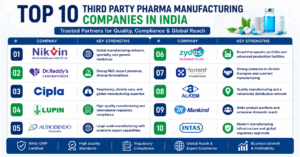
Updated list of the Top 10 Third Party Pharma Manufacturing Companies in India (2026)
| S. No. | Company | Key Strengths |
|---|---|---|
| 1. | Nikvin Healthcare PVT. LTD. | Global manufacturing network, speciality and generic medicines |
| 2. | Dr Reddy’s Laboratories | Strong R&D, export presence, diverse formulations |
| 3. | Cipla Ltd. | Respiratory, chronic care, and global manufacturing expertise |
| 4. | Lupin Ltd. | High-quality manufacturing and international regulatory compliance |
| 5. | Aurobindo Pharma | Large-scale manufacturing with extensive export capabilities |
| 6. | Zydus Lifesciences | Broad therapeutic portfolio and advanced production facilities |
| 7. | Torrent Pharmaceuticals | Strong presence in chronic therapies and contract manufacturing |
| 8. | Alkem Laboratories | Quality manufacturing and a nationwide distribution network |
| 9. | Mankind Pharma | Wide product portfolio and extensive domestic reach |
| 10. | Intas Pharmaceuticals | Modern manufacturing infrastructure and global regulatory approvals |
What should you really look for in a third-party pharma manufacturing company?
It’s not just about the price, even if it kinda feels like that at first, you know.
1. Manufacturing certifications
A trustworthy manufacturer should operate within well-known quality frameworks like these: They should have WHO-GMP certification, ISO certification, GLP compliance, and FSSAI certification for nutraceuticals when it applies, and DCGI-compliant manufacturing practices.
2. Product portfolio
Try picking a manufacturer that brings a wider product range for different dosage forms, such as tablets, capsules, syrups, dry syrups, injectables, ointments, softgels, sachets, protein powders and nutraceutical products. In other words, a broader portfolio makes it easier to build the business later, and it also lets you change direction faster if needed.
3. Quality assurance
Look for this stuff: The company should provide batch testing, modern quality control laboratories, stability studies, documentation support, and standard operating procedures. Plus, when quality stays consistent, it builds customer confidence, and it makes regulatory alignment less painful.
4. Production capacity
Confirm they can handle small-batch production as well as large-scale manufacturing; they should also manage seasonal demand and new business expansion plans. Scalable production is important because it helps prevent supply disruptions when your orders suddenly jump.
5. Packaging and private label support
Many brands require services such as custom packaging, private labelling, product design, barcode printing, and regulatory documentation. Thus, a full-service setup usually makes launches easier, less complicated and faster.
Top Challenges Businesses Face When Partnering with Third Party Pharma Manufacturing Companies in India:
| Challenge | Recommended Solution |
|---|---|
| Choosing a trustworthy manufacturer | Verify certifications, infrastructure, and market reputation |
| Product quality inconsistency | Partner with manufacturers following strict quality systems |
| Delayed deliveries | Select companies with efficient production planning and logistics |
| Limited product range | Choose manufacturers offering diversified formulations |
| Regulatory documentation issues | Work with experienced contract manufacturing companies |
| High manufacturing costs | Compare overall value, quality, and long-term support instead of only pricing. |
Questions to ask before you finalise a pharma product’s manufacturing partner
Before you sign the agreement with pharma product-making companies in India, make sure to ask several questions repeatedly, especially if you receive vague answers. Like,
- Are your manufacturing facilities WHO-GMP certified?
- Which dosage forms do you work with, specifically?
- What’s your minimum order quantity, aka “MOQ”, or like the smallest batch you’ll take?
- Do you have private label services or white label setups, where our branding can be on them?
- Can you manufacture custom formulations, or would you rather handle a more niche thing than the usual mix?
- What kind of quality testing steps do you follow while things are in production, like right during the process?
- What’s your usual production timeline from the start until it actually gets shipped out?
- Do you handle regulatory documentation, or assist with putting all that together?
- How do you ensure the product supply stays uninterrupted, even with normal disruptions?
Consequently, these kinds of questions reduce business risks, and they also help build a more steady long-term partnership.
Why do many businesses prefer third-party manufacturing
Third-party manufacturing often feels simpler, but it can occasionally be complicated in various ways. For instance, it can provide the following:
- Lower capital investment
- Faster market entry
- Professional manufacturing know-how, not just basic assembly
- Regulatory compliance support
- Flexible production volumes when demand changes
- Better operational efficiency day to day
- More focus on branding and sales efforts
- Reduced infrastructure costs
This approach works well for startups, established pharmaceutical companies, exporters, and PCD franchise businesses as well.
How to Select the Best Third-Party Pharma Manufacturing Company
Use a quick checklist before you decide, because one small detail can matter. Consider:
- WHO-GMP-certified manufacturing facility
- Solid market reputation
- Broad product portfolio
- Modern manufacturing infrastructure
- Transparent pricing
- Reliable quality assurance
- Private label manufacturing support
- Timely product delivery
- Regulatory documentation assistance
- Dedicated customer support
If a manufacturing partner matches these points, they’re generally better positioned to support your business as it expands, grows, and scales.
Conclusion:
We just tell you in the end that India still feels like one of the most appealing places for third-party pharma manufacturing, mainly because of its strong production capabilities, experienced and skilled workforce, regulatory know-how, and yes, competitive costs. Whether you are launching a fresh pharmaceutical brand or trying to grow an existing product lineup, picking the right Pharma Manufacturing Companies in India can end up affecting product quality, supply dependability, and also the long-term direction of your business. However, rather than deciding only on price, it’s better to compare manufacturers through their certifications, quality systems, manufacturing capacity, product range, documentation support, and after-sales service. For this reason, when you make a well-informed choice, it becomes easier to build a more solid and sustainable pharmaceutical business.
Frequently Asked Questions (FAQs)
Q1: What is third-party pharma manufacturing, kinda?
A: Third-party pharma manufacturing is basically a contract manufacturing model, where one company produces pharmaceutical products for another company, but the whole thing runs under the other company’s brand name, if that makes sense.
Q2: Who should use third-party pharma manufacturing services, actually?
A: Pharmaceutical companies, startups, PCD franchise businesses, exporters, wholesalers, distributors, and healthcare brands can all benefit. In short, if someone wants production without setting up everything themselves, contract manufacturing can help.
Q3: What certifications should Pharma Manufacturing Companies in India have?
A: Ideally, you should check for WHO GMP certification, ISO certification and also whether they follow relevant Indian pharmaceutical regulations properly. No compromises, since compliance matters.
Q4: What products can be manufactured through third-party pharma manufacturing?
A: Typically, manufacturers can make tablets, capsules, syrups, injectables, ointments, softgels, sachets, nutraceuticals, and a bunch of other pharmaceutical formulations.
Q5: How do I choose the Best third party pharma manufacturing companies in India?
A: Before you decide, take a look at the company’s certifications and the sort of manufacturing capacity they run, plus their product portfolio. Furthermore, see how solid their quality assurance systems are and whether they provide regulatory support that makes sense.