All posts by Nikvin Healthcare Pvt. Ltd.

Pharma B2B Manufacturing Process in Baddi

Top Pharma B2B Manufacturing Process in Baddi

Baddi has quietly become one of India’s biggest hubs for contract pharma manufacturing. If you’re a pharma brand, a distributor, or a healthcare startup looking to get products made without setting up your own factory, understanding the pharma B2B manufacturing process in Baddi will save you time, money, and a lot of back-and-forth with vendors.

This guide walks through how B2B pharma manufacturing in Baddi actually works, from the first conversation with a manufacturer to the day your stock is delivered.

What is B2B Pharma Manufacturing?

B2B pharma manufacturing means one company (usually a manufacturer with its own facility) produces medicines for another company (usually a brand or marketing firm) under contract. The brand generally owns the formula, the packaging design, and the market. The manufacturer handles production, quality testing, and compliance.

This model is enabling pharma companies to launch products without setting up a plant. This is why many brands prefer to use pharma B2B manufacturing services rather than in-house manufacturing.

Why Choose B2B pharma manufacturing in Baddi?

Baddi, in Himachal Pradesh, produces a large share of India’s medicines. In fact, it is counted among the top pharma manufacturing hubs in India. There are solid reasons brands keep coming back here.

Established pharmaceutical ecosystem

Hundreds of manufacturing units are located in and around Baddi. This means raw material suppliers, packaging vendors and testing labs are all close at hand, keeping production moving with no long delays.

Availability of manufacturing infrastructure

Most of the units here are WHO-GMP certified and are meant for large-scale output. Tablet presses, capsule filling lines, liquid manufacturing setups, and injectable facilities are all commonly available.

Skilled workforce and supply-chain support

Decades of pharma activity have built up a workforce that understands formulation, machine operation, and regulatory documentation.

Connectivity with major Indian markets

Baddi sits close to Chandigarh and has good road links to Delhi, Punjab, and northern India. Dispatch to other states is quicker than from many other manufacturing clusters.

Pharma B2B Manufacturing Process in Baddi: How it Works

Step 1: Selection of product and requirement analysis

The brand chooses first the drug formula and the type of dosage—tablets, syrups, capsules, or another form. The manufacturer will determine easibility, dosage requirements and whether the formulation is already developed or needs to be developed.

Step 2: Development of Formulation

For a new product, the R&D team formulates the formula, determines the right combination of active ingredients and excipients, and conducts trial batches to test for stability and efficacy.

Step 3: Purchase of raw materials

The manufacturer sources active pharmaceutical ingredients and other mixing agents. THey purchase only from certified and approved vendors.

Step 4: Raw Material Quality Testing

The sourced raw material is then tested for purity and strength.

Step 5: Production and Manufacturing

The production process takes place in a clean climate controlled room. The ingredients are placed in machines.

Step 6: Process Quality Checks

The manufactured goods are passed through quality checks for measuring weight, thickness, and hardness.

Step 7: Testing of the Final Product

The products are then checked for the overall safety and strength.

Step 8: Label and pack

At this stage, the items are moved to automated packaging lines where are sealed by machines into bottles, strips, or boxes.

Step 9: Quality Approval & Batch Documentation

All production records and test logs are reviewed by quality managers. They clear the batch for safety.

Step 10: Warehousing and Product Dispatch

The finished goods are stored in the right conditions and shipped to the client’s place or directly to distributors depending on the agreement.

What Types of Pharma Products are Produced in Pharma B2B Manufacturing Services

Why Choose Nikvin for B2B Pharma Manufacturing in Baddi

Nikvin is one of the leading names in Pharma B2B manufacturing in Baddi for these reasons.

    WHO-GMP Certified manufacturing units

  • All products pass through facilities that meet international manufacturing standards, not just Indian minimums.
  • Strict sourcing of raw materials

  • Nikvin uses only pre-approved and verified API and excipient suppliers to avoid quality issues.
  • Comprehensive Quality Assurance

  • From raw material to finished product, each batch is tested at several stages before it reaches the client.
  • Broad product portfolio

  • Tablets, capsules, syrups, injections and more – one manufacturing partner for brands to manage instead of juggling multiple vendors.
  • Documentation for transparency

  • Clients get complete batch records and compliance paperwork, and audits and regulatory approval are a lot smoother.
  • On-time delivery & logistics support

  • Baddi’s location and Nikvin’s dispatch planning mean you can expect timely delivery.

The Conclusion

B2B pharma manufacturing in Baddi is suitable for businesses that plan to launch their brands without investing in expensive factories. Any reputed pharma manufacturer like Nikvin Healthcare can manufacture medicines under your brand. This way, you will get “market-ready” products. Baddi has everything to be called a top hub for medicine manufacturing in India—from infrastructure, resources, logistics, and raw materials.

FAQs

Q1: What is B2B pharmaceutical manufacturing?
A:
It is a model in which one company makes drugs for another to sell under its own name.

Q2: Why is Baddi preferred for pharma manufacturing?
A:
Baddi has modern plants and skilled workers, good roads and strong local industry support.

Q3: What is the Pharma B2B Manufacturing process in Baddi?
A:
The steps are Formula Selection, Material Buys, Lab Tests, Batch Runs, Quality Checks, Packing and Final Dispatch.

Q4: Do Baddi manufacturing units have any certification?
A:
Yes, all leading plants in Baddi follow the safety guidelines of WHO-GMP.

Q5: What products can companies manufacture through B2B pharma manufacturing in Baddi?
A:
Tablets, capsules, liquids, injections, skin creams and supplements are made by the local companies.

Q6: What paperwork do I need to begin with?
A:
You need a valid Drug License, GST number, trademark for your brand and a signed manufacturing deal.

Q7: How about the production time?
A:
Orders are typically processed within 30 to 45 days. For repeat orders, it may take 20-30 days.

Q8: Do the plants do stability testing of products?
A:
Yes. To determine the correct shelf life dates, plants store test samples in climate rooms.

Q9: How does Nikvin help with B2B pharma manufacturing?
A:
Nikvin is a trusted pharma B2B manufacturing service with modern plants, quality checks and quick order shipping.
What Is Private Label Pharma Manufacturing and How to choose Best Private Label Pharma Manufacturer in Baddi

What Is Private Label Pharma Manufacturing and How to choose Best Private Label Pharma Manufacturer in Baddi?

If you are looking to sell medicines under your own brand name without setting up a factory, you must have heard about private label pharma manufacturing. It’s one of the quickest ways to launch your own product line. Baddi, located in Himachal Pradesh, has quietly emerged as one of India’s largest hubs for it.

In this blog, we will discuss what private label pharma manufacturing is, why Baddi is so important for it and how to select a manufacturer that will not let you down.

What is Private Label Pharma Manufacturing in Baddi?

Private label pharma manufacturing is a kind of contract manufacturing. In this model, a specialised manufacturing unit produces pharmaceutical formulations that are packaged and sold under the brand name of another company.

In other words, any company can order tablets, capsules or syrups, have them made up to their own specifications and shipped out with their own brand on the box.

This way, you don’t need to set up a factory, buy equipment, or hire staff. The manufacturer takes care of formulation, production, quality control and packaging. As a result, you can focus on sales, marketing and brand building.

There are many private label pharma manufacturing in Baddi. This is because Baddi offers tax benefits, skilled labour, and a dense cluster of WHO-GMP certified units.

How Private Label Pharmaceutical Manufacturing Works

  • Select the products you want to sell – this could be a general range, antibiotics or nutraceuticals.
  • The manufacturer provides formulation, pricing and minimum order quantities.
  • You choose and approve packaging design, brand name and labelling.
  • The manufacturer makes the batch and ships it to you.

Why Baddi is a Hub for Private Label Pharma Manufacturing

Baddi, in the industrial belt of Himachal Pradesh, has hundreds of pharmaceutical units. Here are some of the reasons why so many brands prefer private label pharma manufacturing in Baddi over other clusters:

  • Tax incentives that help keep production costs lower than in many other states.
  • Large pool of plants certified to WHO-GMP and ISO, making it easier to find quality compliance.
  • Organised supply chains for raw materials, packaging and logistics.
  • Manufacturing experience over many decades, with many units running here since the early 2000’s.

When starting a pharma franchise or PCD business, these factors add up to less risk and faster turnaround.

How to Choose the Best Private Label Pharma Manufacturer in Baddi?

Not all the manufacturers in Baddi will suit your business in the same way. Some focus on antibiotics, others on a general range, or nutraceuticals. Consider the factors given below to choose the right private label pharma manufacturer in Baddi.

Check certifications first

Your private label pharma manufacturer in Baddi should have at least WHO-GMP, ISO, and GLP certifications. This is not just paperwork. It tells you if the plant is clean, if it tests and documents properly. Ask to see the certificates; do not take the word of a website.

Check Out the Product Range on Offer

A good private label manufacturing company in Baddi generally has a wide catalogue: tablets, capsules, syrups and sometimes nutraceuticals as well. The wider range means you can expand your product line later without changing manufacturers.

Ask About Minimum Order Quantities & Pricing

MOQs vary widely by manufacturer. Some are flexible for smaller businesses; others require bulk orders. Get the full price up front, including packaging costs. No surprises later.

Packaging Review and Brand Support

That’s the true power of private label pharma manufacturing in Baddi. Good manufacturers can offer design support for cartons, strips and labels and can replicate your brand’s look on each product. Ask for samples of previous packaging work before you sign up.

Confirm delivery schedules and shipping

Ask how long it usually takes them to ship, and how they deal with large or rush orders.

Read Client Testimonials and Request References

A manufacturer that is confident in its work will be happy to provide references. Call up a few clients directly. Ask them about consistency, communication, and how quickly problems are sorted out when things go wrong.

Verify regulatory documentation support

You will need to have drug licences and the other paperwork in place to open a PCD franchise or a full distribution business. The right partner for private label pharma manufacturing in Baddi will walk you through.

Factor to Check What to Look For Why It Matters
WHO-GMP & ISO Certification Valid and verifiable certificates Helps assess manufacturing and quality standards
Product Range Tablets, capsules, syrups, nutraceuticals, etc. Makes future product expansion easier
MOQ Flexible minimum order quantity Important for startups and growing brands
Pricing Product + packaging + other applicable costs Helps calculate the actual investment
Packaging Support Custom cartons, labels and strips Helps maintain consistent brand identity
Quality Testing Batch testing and QC documentation Supports product quality and consistency
Production Capacity Ability to handle repeat and bulk orders Reduces supply delays as demand grows
Delivery Timeline Clear production and dispatch schedule Helps maintain inventory and market supply
Regulatory Support Documentation and compliance guidance Makes the process easier for new businesses

Start Your Private Label Pharma Manufacturing with Nikvin Healthcare

Nikvin Healthcare, situated on Baddi-Barotiwala Road in Himachal Pradesh, is one of the well-known manufacturers in private label pharma manufacturing in Baddi. We are a WHO-GMP-certified facility and manufacture tablets, capsules, cephalosporins, antibiotics, general range medicines and nutraceuticals. To learn more, please contact us at +91 8920017174, +91 9212717109, and +91 7217789705.

Final Thoughts

Baddi houses several private label pharma manufacturers to choose from. However, it is important to assess them on certifications, quality, pricing, and delivery timeline. It helps you choose the right one.

FAQs on Private Label Pharma Manufacturers in Baddi

Q1: What is private label pharma manufacturing?
A:
Private label pharma manufacturing is a kind of contract manufacturing in which a specialised manufacturing unit produces pharmaceutical formulations that are packaged and sold under the brand name of another company.

Q2: Why is Baddi known for pharma manufacturing?
A:
This is due to tax benefits, a large number of WHO-GMP certified units, skilled labour, and strong supply chains. All these factors help to keep costs low and quality high.

Q3: What’s the difference between private label and third-party manufacturing?
A:
In private label manufacturing, a manufacturer builds a pre-formulated product that you can rebrand and sell as your own. Third-party manufacturing means products are made specifically to a client’s custom formulas, design, and specifications.

Q4: What is the MOQ of private label products?
A:
It depends on the product and the manufacturer. Some will accept smaller trial orders; some have higher MOQs.

Q5: Do I need a drug licence to sell private label medicines?
A:
Of course, yes. Even if you are not manufacturing your own pharmaceutical products, you will need a wholesale drug licence to market and distribute pharmaceutical products in India.

Q6: Do I get to select my own packaging design?
A:
Most manufacturers in this space offer full customisation of cartons, strips and labels to match your trademark.

Q7: How long will it take to get products made and delivered?
A:
It depends on the product and the order size. However, most manufacturers will be able to turn around a batch in a few weeks once the formulation and packaging are finalised.

Q8: What should I look for in a manufacturer in terms of certifications?
A:
The most important ones are WHO-GMP, GLP and ISO 9001. They confirm the plant meets accepted quality and safety standards.

How to Choose the Right Contract Manufacturing Partner – Why It Matters

How to Choose the Right Contract Manufacturing Partner – Why It Matters?

Most pharma businesses prefer contract manufacturing over setting up their own factory.

It saves them the cost and hassles associated with running a manufacturing plant, including compliance, equipment and hiring staff. You just pay for manufacturing. But choosing a contract manufacturing partner is a big decision.

The right partner will ensure consistent quality and timely delivery of batches. Otherwise, you will face delays, compliance problems and products that don’t match your label claims. Third-party manufacturing has become the backbone of India’s pharma business. Small and mid-size brands don’t need to build their own plants anymore.

They team up with a trusted third-party pharma manufacturer, focus on sales and marketing, and let the experts handle production.

So how do you pick one? Let’s walk through it.

Why Choosing a Good Third-Party Manufacturing Partner Matters?

Your product is only as good as the factory that makes it. You can have a great sales team and a strong brand story. None of that helps if your tablets fail a test or your batches show up three weeks late.

A weak manufacturing partner causes problems that surface later, often when it’s too late to fix quietly. The poor quality of your products costs you your clients’ trust. It also makes you prone to legal complications.

This is why choosing a contract manufacturing partner requires careful thought. Don’t just go with the lowest quote.

How to Choose best Contract Manufacturing Partner

Before you choose any third-party pharma manufacturer, make sure to evaluate them on these factors:

Licences and certifications

Ask for WHO-GMP certification, GLP compliance, and a valid drug manufacturing licence. These certifications show that the manufacturer follows international guidelines in manufacturing and management. Also, review these “papers” for expiry date, name and address, and permission to make your drugs.

Nikvin Healthcare fulfils this metric with its updated WHO-GMP and ISO certifications.

Plant capacity and product range

Can they handle your volume today, and your growth plans for next year? This is really an important thing to consider. Otherwise, you may switch to other vendors if you are looking to add five more products that are not available with the existing one. This means that you have to start the process from scratch with each new vendor. And it can delay product launches, fragment your supply chain, and increase overhead costs.

Nikvin Healthcare has a wide range of pharma products, including tablets, capsules, syrups and ointments. You can add new products with us without switching partners each time.

Quality control

Ask how batches get tested, what equipment they use, and who signs off before release. A manufacturer with proper in-house labs catches problems early, not after the product reaches your stockists.

For example, Nikvin Healthcare has a complete quality assurance system in place to deliver high-quality, safe, and effective formulations to our clients.

Raw material sourcing

Where do the active ingredients come from? A manufacturer who sources from approved, traceable suppliers gives you fewer surprises down the line.

Using unvetted or substandard materials can create serious supply chain disruptions, unexpected batch failures and costly delays. That’s why we at Nikvin Healthcare source strictly from authorised sources to maintain the quality and efficiency of products.

Timely Delivery

If everything seems fine, whether it is a certificate or quality, then it may be their delivery system that can let you down. Delays in getting products can impact your brand’s reputation and cause stockouts.

At Nikvin Healthcare, we are backed by a strong supply chain system with streamlined workflows. It guarantees that your products will be delivered on schedule.

Contract Manufacturing vs. Building Your Own Plant

Some brands wonder if they should build their own facility instead. For most companies, that’s the wrong call.

A WHO-GMP plant costs crores of rupees and takes years to set up. A good third-party pharma manufacturer already has the licences, the machines, and the trained staff ready to go. You save money. You save time. And you launch faster.

This is where manufacturing partnership opportunities come in. Working with a name like Nikvin Healthcare means you’re not starting from zero. You step into a set-up that’s already tested and already running at scale.

Mistakes to Avoid While Choosing a Pharma Contract Manufacturer

  • Many pharma businesses choose the first manufacturer they come across. Rather, you should request quotes from 4-5 manufacturers and assess them for certifications, on-time delivery and other factors.
  • The lowest price can be attractive. But it could be because the manufacturer is compromising on quality. Always prefer value over price.
  • Don’t choose partners who are unsure about lead times, batch records, or audit access. Open communication is important for a smooth long-term partnership.

Conclusion

Contract manufacturing is a smart model. But it only works if you pick the right partner.

Choosing the right contract manufacturing partner is an important investment in the future of your pharma brand. Their regulatory compliance, plant capacity, strict quality control and transparent raw materials ensure quality products on time. And this leads to market success.

Working with a reliable manufacturer like Nikvin Healthcare can help you remove manufacturing headaches. You can maintain product quality and concentrate on growing your brand. So, take your time to consider your options. The right partnership will act as a solid foundation for your pharma business.

Frequently Asked Questions

Q1: What is contract manufacturing in the pharma industry?
A:
This is when you hire a company to manufacture medicines under your brand’s own label. The brand manages sales and marketing. The manufacturer manages production.

Q2: Why do brands prefer third-party manufacturing instead of setting up their own plant?
A:
Building a plant is a huge investment and years of work. Third-party manufacturing allows a brand to launch fast using the manufacturer’s existing licences, machines and staff.

Q3: Can a contract manufacturer handle custom formulations?
A:
Many can, including Nikvin Healthcare. They support product development for brands who want an exclusive product line.

Q4: What is the minimum order quantity for 3rd party manufacturing?
A:
This varies based on a manufacturer and product type. Clarify it early, since it affects your upfront cost.

Q5: How long does it take to launch a product through contract manufacturing?
A:
It depends on the product. An existing formulation moves faster than a new one that needs fresh development work.

Documents Required for Third Party Pharma Manufacturing

What Are the Required Documents to Work with a Pharma Third-Party Manufacturing Company?

Starting a pharma brand without your own factory is easier than you think. You pick a formula. You find a maker. The products land at your door, ready to sell.

But before any of that happens, you need to go through paperwork. A third-party pharma manufacturer asks for certain documents before starting the process. If your files aren’t in order or any document is missing, even the best third-party pharma manufacturing partner may not work with you.

This guide covers every document or paper you need. It explains why each paper matters. It also shows how first-time pharma businesses can avoid delays.

Why Documents Matter in Third Party Pharma Manufacturing

Pharma isn’t like other trades. Every tablet, syrup, or shot that leaves a factory gets tracked and licensed. A pharma third-party manufacturing company can’t make a single batch until they verify your papers.

These papers include permits and documents, including a GST number, a drug license and business registration. It proves that your business is genuine and registered. It also means your products can be sold without legal trouble down the line.

Make sure to secure each and every document before ordering a pharma manufacturing company. Otherwise, you’ll lose weeks waiting.

Documents Required by a Pharma Third-Party Manufacturer

Business Registration Papers

Every 3rd Party Pharma Manufacturing deal starts with proof that your firm exists. You’ll usually need:

  • Certificate of incorporation, partnership deed, or proof of sole ownership
  • PAN card of the firm or owner
  • GST certificate
  • Company letterhead and bank details for billing

Without these, no third-party pharma manufacturer will sign a deal with you. It’s the first checkpoint. It’s not optional.

A Drug Licence

This is where many new brands get stuck. To sell pharma products in India, you need a valid Drug Licence. It can be a wholesale or retail licence, based on how you plan to sell.

If you don’t hold one yet, most third-party pharma manufacturing firms can help you get it. Your state’s Drug Control office issues the licence. It often takes a few weeks. Apply early. Don’t wait until your product list is final.

Trademark and Brand Papers

Your brand name is your face in the market. Protect it before you print it on one box. You’ll need:

  • A trademark filing or registration certificate
  • A no-objection letter, if the brand sits under a different firm in your group

Good third-party pharma manufacturer partners check that your name doesn’t clash with others already on the market. Making products under a disputed name causes trouble for both sides.

Product List and Formula Details

Once your business and brand papers are set, pick exactly what you want made. This means:

  • A clear product list with dosage type, strength, and pack size
  • Reference formulas, if you’re using an existing one
  • Packaging design files, or a brief for the maker’s design team

A solid third-party pharma manufacturing company checks each formula against WHO-GMP and Schedule M rules before it starts production.

Manufacturing Deal and Order Form

Once your papers and product list get the green light, the maker sends a formal deal. It covers price, minimum order size, delivery dates, and who owns quality faults. You sign this along with your first order form, which confirms:

  • Product names and amounts
  • Pack specs
  • Delivery date and payment terms

Read this deal with care. It sets out what happens if a batch fails a check, or a delivery runs late.

Document Category Documents Required Where to Get It in India
Business Registration Papers Certificate of incorporation, partnership deed, or proof of sole ownership
PAN card of the firm or owner
GST certificate
Company letterhead and bank details for billing
Registrar of Companies (incorporation), local registrar (partnership deed),
Income Tax Department (PAN), GST portal (GST certificate)
Drug Licence Wholesale or retail Drug Licence, depending on how you plan to sell State Drug Control office. Most third-party manufacturers can help you
apply if you don’t already hold one. Allow a few weeks and apply early.
Trademark and Brand Papers Trademark filing or registration certificate
No-objection letter, if the brand sits under a different firm in your group
Trade Marks Registry (India), via the IP India online portal or a trademark agent
Product List and Formula Details Product list with dosage type, strength, and pack size
Reference formulas, if using an existing one
Packaging design files, or a brief for the maker’s design team
Compiled by you; checked by the manufacturer against WHO-GMP and
Schedule M rules before production starts

Papers You Need From Your Manufacturer

Make sure to ask for copies of the documents from your manufacturers as given below:

  • WHO-GMP certifications
  • Permits/approval for making certain products like injectables
  • AYUSH certificate for herbal products
  • BATCH COA
  • Documents for manufacturing vet products

Common Mistakes to Avoid

Many beginners in the pharma business tend to make mistakes, leading to delays and other issues. Here are some of them you should not make:

  • Don’t send an expired GST certificate.
  • Avoid filing a trademark after production starts, as it can lead to a last-minute packaging change.
  • Don’t apply late for a Drug License.

Start your papers early. Keep digital copies of everything. Ask your maker exactly which files they need before you begin.

How Nikvin Healthcare Simplifies the Process

Nikvin Healthcare, as a reliable third-party pharma manufacturer, works closely with new and old pharma businesses to make the paperwork stage simple. We explain each partner through the exact papers needed, check formulas against the rules, and keep things moving from deal to first dispatch.

For anyone new to third-party pharma manufacturing, that kind of support often makes the difference between a smooth launch and a stalled one.

Conclusion

Getting your papers right isn’t the fun part of launching a pharma brand. But it decides whether your first order ships on time.

Whether you’re new to third-party pharma manufacturing or switching makers, it is important to keep your papers ready. Having your business papers, Drug Licence, trademark, and product in place will save you hassles and complications. Pick a maker who explains the steps in plain terms, and the paperwork stops feeling like a wall.

FAQs

Q1: What is the least paperwork I need to start with a pharma third-party manufacturing company?
A:
You will need to have your firm registration proof, PAN and GST details and a valid Drug Licence. Other papers like trademark certificates can be submitted later on when you start production.

Q2: Can I start Third Party Pharma Manufacturing without a Drug Licence?
A:
No. It is mandatory to have a Drug Licence to sell pharma products in India. Most makers can guide you through the form if you don’t hold one yet.

Q3: How long does the paperwork take?
A:
It varies. Drug Licence approval alone can take a few weeks. Firm registration and trademark filing can run at the same time to save you time.

Q4: Do I need a trademark before I approach a third-party pharma manufacturer?
A:
It’s not always a must to hold a registered trademark. But a filed application is a smart move before you print any packaging.

Q5: What happens if my papers are incomplete?
A:
Production simply won’t start. Pharma manufacturers must check your papers before running any batch, so missing files mean delays.

Third Party Pharma Manufacturing Company for Startups

Why Third-Party Pharma Manufacturing Is Ideal for Startups?

Starting a pharma company is exciting.

But for most startups, that excitement doesn’t last long as they face the reality of building a factory. It takes crores of rupees to buy a property, machines and hire staff. Securing important permits for compliance adds even more stress.

That’s where a pharma manufacturing for startups comes in.

A third-party pharma manufacturer produces medicines for you, helping you grow your business.

If you are new to this model and wonder how it can help, this blog is for you. Let’s get started.

How 3rd Party Pharma Manufacturing Supports Startups Pharma Companies?

Also known as contract manufacturing, third party pharma manufacturing for startups is a simple business model.

You choose your formulas, your packaging, and your brand name. Once you are done with that, you submit them to the manufacturer. The manufacturer makes the medicines under your label. They follow your specs and your quality standards.

This way, you never have to be involved in the manufacturing of the medicine ever. Yet you own the product from start to finish. As the manufacturer handles the production, you get market-ready products. You can focus entirely on the sale and marketing of those products.

Why Startups Prefer Third-Party Pharma Manufacturers as a Good Choice

Lower Cost, Faster Launch

Setting up a pharma plant in India can cost ₹2 crore to ₹10 crore or more, before you’ve sold a single strip of tablets. Not all startups can afford such a huge investment. With 3rd party pharma manufacturing, you don’t need to worry about this necessity at all. They manufacture medicine for you. You pay per batch or per order. There’s no loan on machinery, no warehouse rent sitting idle, no staff salary running every month whether you sell products or not. Your money goes into what actually grows the business: marketing, field staff, and doctor visits.

Creating a Strong Brand Identity

Third-party manufacturing is a great way for entrepreneurs to grow and market their own pharmaceutical brand. The offer services like packaging, and branding tailored to your requirements.

Reducing Launch Time

Building a plant and getting it certified can take a couple of years. A good third-party partner is already certified and producing. Your first batch can be ready in weeks, not years.

Quality You Couldn’t Build Alone

A new company can rarely afford the quality systems that bigger manufacturers already have. A trusted third-party manufacturer is equipped with everything required to ensure product quality. They have a WHO-GMP certified plant, tested machines and trained quality staff.

Letting You Focus on What Builds a Brand

Manufacturing is only one part of a pharma business. The real work happens in the market: building a strong field team, training your reps, forming ties with doctors, and designing packaging that stands out on a shelf.

When you’re not chasing machine breakdowns or going through compliance hassles, you can focus on these essentials quite well.
Pharma manufacturing for startups through the third-party route means you outsource what you don’t need to control, and pour your energy into what you do.

Giving a Room to Test and Grow

You might launch with fifteen products and find only six sell well. With your own factory, changing course is slow and costly, since you’re stuck with machines built for products that aren’t moving.

Third-party manufacturing gives you room to test. Want to add a new segment? Place an order. Want to drop a slow product? Just stop ordering it. Pharma manufacturing for startups built this way lets you follow the market, not your factory’s limits.

Offering a Wider Range without the Risk

A startup with its own plant usually picks one or two types, since the cost of machines for each type adds up fast.

Working with a partner means you can offer a full range from day one: a tablet line, a syrup range, and an injection line, all without owning a single machine. This makes a young brand look far more established than it is, and gives your team more products to offer doctors on each visit.

Helping With Paperwork

Drug licences, GST papers, product approvals, and forms for every state you sell in can be overwhelming for new pharma firms. Manufacturers who’ve done this hundreds of times can guide you through it, instead of leaving you to figure it out alone.

3rd Party Pharma Manufacturing for startups isn’t just about making pills. It’s a partnership. The manufacturer’s years of experience fill in gaps a new founder hasn’t covered yet.

Enhancing business profitability

Setting up a manufacturing plant involves a huge investment in equipment, manpower, quality control and regulatory compliance. By outsourcing production, many of these costs are eliminated, helping companies increase their overall profit margins.

Reducing manufacturing risks

Pharmaceutical manufacturing requires strict quality mandates and government regulations. Working with a good manufacturer lets you focus on growing your business. Also, it lowers the risks of delays, quality issues, regulatory non-compliance, and product recalls.

Pitfalls of Pharma Startups: Choosing the Wrong Manufacturing Partner

While the benefits of working with a third-party are quite evident, there are some mistakes that can cost the quality and your reputation.

1. Putting low prices above quality

Selecting a manufacturer only because they have the lowest price can be a ghastly mistake. It could lead to a poor-quality product that will ruin your brand’s reputation. Make sure to compare quality standards before you decide.

2. Forgetting to Check Regulatory Certifications

A trustworthy manufacturing partner should have the required certifications and approvals. Failing to check these can lead to legal and compliance issues later on.

3. Not accounting for production capacity

Your manufacturing partner should be able to develop with your firm. If you don’t have the production capacity, you may not be able to launch products on time, and you may miss out on opportunities to satisfy a growing market need.

4. Not Acknowledging the Power of Communication

Transparency and timeliness in communication are vital to a successful cooperation. Delays in approvals, production updates or delivery information might damage operations and affect customer satisfaction.

Nikvin Healthcare is Your Trusted Third-Party Pharma Manufacturer

By this point, you must have understood some key benefits of working with a third-party pharma manufacturer. If you are looking for the right one, look no further than Nikvin Healthcare. We offer a range of WHO-GMP certified pharma products across tablets, capsules, syrups, and other forms, built around the needs of new pharma brands. Startups working with Nikvin get help with formulas, packaging, and paperwork too, alongside the manufacturing itself. That takes real pressure off a small founding team. To learn more, please contact us at +91 8920017174 and +91 9212717109.

The Conclusion

A third-party pharma manufacturer eliminates the need to set up your own factory. This is because they handle this responsibility. This saves you money, hassles, and complications. As a result, you can entirely focus on the sales and marketing of your products. However, it is important to choose the right one.
Check if the manufacturer has a WHO-GMP-certified facility, has a wide range of products and has a fast delivery system.

FAQs

Q1: What is third-party pharma manufacturing?
A:
This is a business model in which a third-party pharma manufacturer produces and labels medicines for you, as per your formulas and packaging.

Q2: Is it good for a very small startup?
A:
Yes. It’s often the only real option, since it removes the need for heavy upfront spend on machines and buildings.

Q3: How do I check if a manufacturer is reliable?
A:
Look for WHO-GMP marks, ask for names of clients, examine sample batches and visit the plant personally if possible.

Q4: Can I change my line of products later?
A:
Yes. You can add or drop products depending on the market reaction, without the fear of idle machines.

Q5: What papers do I need to start?
A:
Usually your drug licence, GST papers, and company papers. A good manufacturer will guide you through anything else.

Third Party Pharma Manufacturing Cost in India

How Much Investment is Needed for Pharmaceutical 3rd Party Manufacturing? (Pharma Manufacturing Cost Guide 2026)

For a small startup looking to launch a portfolio of 5 to 10 products, the initial third-party pharma manufacturing cost in India is generally between ₹ 2 Lakh and ₹ 5 Lakh. This first investment includes your government licenses, your brand logo designs and your very first batch of product.

But that doesn’t mean you pay the money and get started with the manufacturing of medicines. Make sure to know how that cost is divided. Also, it is important to know how you can lower that cost.

Let’s walk through this pharma manufacturing cost guide to learn how to maximise every rupee of your investment in 2026.

Working with a Pharma Third Party Manufacturing Company?

In the past, you needed to spend millions of rupees to build a giant factory just to make one pill!

But today, things are completely different. Thanks to third party pharma manufacturing company, you can hire an existing, fully licensed factory to make the medicines for you. You get to put your own brand name on the box, and they handle all the manufacturing responsibilities in the laboratory.

It saves your money, time, and the headache of compliance.

Step by Step Guide of Third Party Pharma Manufacturing Cost

To understand the overall pharma manufacturing cost, we are going to divide your budget into two parts: Fixed Setup Costs (the costs that you pay once) and Variable Production Costs (the costs to make the actual medicines).

1. Fixed Setup Costs (One-Time Payments)

First of all, you have to pay for the legal paperwork, documents and permits. It includes:

    Drug License:

  • To be able to sell your medicines legally in India, drug license is mandatory. The licenses can cost anywhere between ₹15,00 to ₹ 10,000. It depends upon the license types (wholesale, retail or manufacturing).
  • GST Number:

  • For tax compliance, you will also require to have GST number and its registration cost can vary between ₹1,000 to ₹5,000.
  • Trademark Registration:

  • To protect your brand name, trademark registration is very important, and it can cost you anywhere between ₹4,500 to ₹6,000 to register each product name.
  • Packaging Design:

  • You may need to get the services of a graphic designer for designing your boxes and labels and it can cost you anywhere between ₹ 5,000 and ₹ 15,000 for such design work.

The cost for this design work can range between ₹ 5,000 and ₹ 15,000.

2. Variable Production Costs (Per Batch)

You pay the manufacturer to buy raw materials and run their machines. The cost of your total pharma manufacturing company depends on the type of medicine you are manufacturing.

Here’s what a standard batch generally costs in 2026:

Product Type Average Minimum Order Quantity (MOQ) Estimated Cost Per Unit
Tablets & Capsules 30,000 to 50,000 units ₹0.80 to ₹3.20 per strip
Liquid Syrups 5,000 bottles ₹18 – ₹35 per bottle
Injections (Vials) 5,000 to 10,000 units ₹50 to ₹150+ per piece

Pro Tip on Batch Costs: Factories have a rule called Minimum Order Quantity (MOQ).

For example, they won’t just make 100 tablets for you; they usually require a minimum run of 30,000 tablets to start their massive machines. A single batch run for one tablet product usually sits between ₹60,000 and ₹95,000

Quick Summary: Third-Party Pharma Manufacturing Cost

Based on the breakdown above, here is a table giving you a glance at the total third-party pharma manufacturing cost.

Expense Type Cost Item / Product Type Minimum Order (MOQ) Estimated Investment (2026) Approximate Total per Category/Batch
Fixed Setup Costs (One-Time) Drug License, GST Registration, Trademarks, & Packaging Design N/A Varies per item ₹12,000 to ₹36,000 (Total legal & design setup)
Variable Production (Per Batch) Tablets & Capsules 30,000 to 50,000 units ₹0.80 to ₹3.20 per strip ₹40,000 to ₹95,000 (Per product batch)
Variable Production (Per Batch) Liquid Syrups 5,000 bottles ₹18 to ₹35 per bottle ₹90,000 to ₹1,75,000 (Per product batch)
Variable Production (Per Batch) Injections (Vials) 5,000 to 10,000 units ₹50 to ₹150+ per piece ₹2,500,00
How this cost works:

For example, you are looking to launch your tablet brand. So the cost will be like this:

₹ 40,000 (production cost) + 12,000 (legal permits and documents cost) + GST (12% to 18%).

This way, your final pharma manufacturing cost for a single product will go around ₹55,000 to ₹60,000! However, expect the cost to go above 2 lakh if you want to run a decent business with a broader product portfolio.

Major Elements That Affect Your Total Investment

Pharma brand startup price isn’t one size fits all. Your final pharmaceutical manufacturing cost will depend on a few different choices:

    Quality of Raw Materials (API):

  • An active chemical in a medicine is called an API (Active Pharmaceutical Ingredient). Premium-grade, highly pure APIs cost more, but they guarantee your medicine is safe and works properly.
  • Type of Packaging:

  • Regular plastic foil is a very cheap way to wrap your tablets. If you want to use high-end “Alu-Alu” (double aluminium) packaging to protect the pills from moisture, your packaging costs will be higher.
  • Order Volume (The Bulk Discount):

  • The more pieces you order at one time, the less you pay for each piece. If you do a small test run and scale it up to 10,000 units, you can reduce your per-unit cost by as much as 40%!

Nikvin Healthcare: Your Budget-Friendly Pharma Partner

If you are looking to start your business smoothly without getting overwhelmed by high initial costs, Nikvin Healthcare is the perfect partner to choose.

Nikvin Healthcare provides new entrepreneurs and growing brands with easy, highly flexible and budget-friendly third-party manufacturing services. They understand that startups need to save capital, so they have lower Minimum Order Quantities (MOQs) than rigid, giant factories. With their state-of-the-art facilities, supportive guidance during the drug licensing phase and affordable batch rates, Nikvin Healthcare enables you to launch premium quality healthcare products within your budget.

Frequently Asked Questions

Q1: Is it possible to launch a pharma brand without a factory?
A:
Yeah! That’s exactly why third-party manufacturing exists. You can get your products manufactured by them without even setting up a factory.

Q2: What is the absolute minimum third-party pharma manufacturing cost for a product?
A:
For one product launch (like a batch of basic multi-vitamin tablets), it can cost you in the range of ₹50,000 to ₹80,000 for the production batch and your initial one-time license fees.

Q3: How long will it take for me to receive my first order?
A:
Usually, the first batch takes around 35-45 days. That’s because the manufacturer has to review your legal documents, approve the box designs, and test the ingredients. Repeat orders are much quicker, usually taking only 20 days.

Q4: Do you need a science degree to start this business?
A:
No, you do not need to have a special pharmacy degree to own a pharma marketing company. You will, however, need to register a valid wholesale drug license. If you are not from a pharmacy background, you can simply hire a qualified technical person to legally manage your inventory records.

Q5: What is the GST on the manufacturing of medicine?
A:
Yes, the manufacturing of medicine is taxed by the government. Typically, the GST rate for pharmaceutical goods is between 12% and 18%, depending on the particular health classification of the product.

B2B Pharma Portal For Third Party Manufacturer

What Are B2B Pharma Manufacturers & Why Nikvin is the Best Choice for Pharma B2B Supplier?

Best B2B Pharma Platform for Third Party Manufacturer

Pharma B2B manufacturers produce medicines and pharma products for other companies. They are also known as a contract manufacturer and a third-party manufacturer.

In this blog, we will explain precisely what these manufacturers do. We will also talk about how pharma B2B suppliers work and why Nikvin Healthcare is the ultimate choice.

What are Pharma B2B Manufacturers in India?

Pharma B2B manufacturers in India are the pharmaceutical companies that manufacture medicines for other businesses and not for direct sale to consumers. In other words, pharma companies hire them to get their products manufactured.

These manufacturers produce medicines in accordance with the client’s requirements. The client then sells these medicines under its own brand name. This type of business model allows companies to save time, reduce investments and release products much faster.

For example, you want to launch your liver tablets. But you don’t have the budget to set up a manufacturing facility or factory. In this scenario, you can hire a pharma B2B manufacturer to get those liver tablets produced. This is also known as third party manufacturing or outsourcing.

You can find them using any B2B pharmaceutical marketplace.

Generally, the clients of any pharma B2B manufacturer include:

  • Pharmaceutical companies
  • Healthcare brands
  • Export companies
  • PCD Pharma Franchise Company
  • Suppliers to hospitals
  • Medicine distributors
  • Wholesalers

How Do They Work

It is important to understand how these B2B pharma manufacturers work. Here are some simple steps to understand the process:

  • Step 1: Business shares product requirements with a B2B manufacturer.
  • Step 2: Manufacturer develops/manufactures product
  • Step 3: Quality testing completed
  • Step 4: Packaging and labelling are carried out
  • Step 5: The products are sent to the client

This system enables businesses to focus on sales and marketing while experienced manufacturers take care of production.

Why Do Businesses Prefer Pharma B2B Manufacturers in India

Not all businesses want to build a factory. That’s where pharma B2B suppliers come in. They have already got the machines, the staff and the licenses ready. You order, they do the rest.

Working with a good pharma B2B supplier means you get access to quality checks compliant with government regulations. This makes your product safe and reliable for those who use it.

Here are some key advantages of partnering with pharma B2B suppliers

  • Quality of product consistency
  • Cost-effective manufacturing
  • Facilities of modern production
  • Professional packing
  • Quicker delivery
  • Technical support
  • Regulatory compliance
  • Long-term business partnership

These benefits help in the faster growth of businesses in the competitive pharmaceutical market today.

Typical Products Made by B2B Pharmaceutical Manufacturers

B2B Pharmaceutical manufactures a variety of healthcare products, including:

  • Tablet
  • Capsule
  • Syrups
  • Juices
  • Syrups dry
  • Antibiotics
  • Cephalosporin’s
  • Nutraceuticals
  • Products for general medicine

Why Nikvin is a Reliable B2B Pharma Manufacturer

When you are choosing from Pharma B2B Manufacturers in India, the most important factors are quality, experience and reliability. And Nikvin ticks all these boxes of becoming an efficient pharma company.

Operating from Baddi, the company has over 15 years of pharmaceutical manufacturing experience. Most importantly, we are certified by WHO-GMP, GLP & ISO 9001 quality system. We deal in a wide range of generic medicines. We produce antibiotics (such as Cephalosporins), tablets, capsules, dry syrups, nutraceutical supplements, cardiac care medicines and diabetic management products.

Nikvin Healthcare has successfully served over 400 satisfied clients & secured over 500 product approvals. We remove the stress of manufacturing so that healthcare brands like you can focus on marketing and helping people live healthier lives.

From a small test batch of a new health supplement to a huge bulk supply of painkillers for a nationwide distribution network, Nikvin’s infrastructure can handle it. We cater to private household clients and can even handle big government tenders. We also have more than 40 types of modern packaging styles to keep the drugs fresh and protected from humidity and heat.

To learn more, please contact us at +91 8920017174 or +91 9212717109. We would be happy to help you.

How to Choose the Right Pharma India B2B manufacturers

Picking the right B2B Pharmaceutical Manufacturers is not something to rush. Here are a few simple things to check before signing any deal:

  • Do they have WHO-GMP or ISO certification?
  • How many years have they been in the pharma business?
  • Do they have a wide range of products?
  • Do they have the trust and recommendation of their previous clients?
  • Do they have modern machines and a clean and well-run plant?

These companies that satisfy all these requirements are generally the safest pharma B2B manufacturers to work with in India. We take pride in the fact that we satisfy all requirements to be your reliable B2B pharma company.

The Conclusion

Finding the right partner among pharma B2B manufacturers in India can help you grow your business. Make sure to choose a certified company. Also, they should have good customer support and a vast product portfolio. Nikvin Healthcare has everything to become your trusted B2B pharma manufacturer in today’s competitive market.

Frequently Asked Questions

Q1: What are Pharma B2B Manufacturers in India?
A: They make pharmaceutical products for businesses such as pharmaceutical companies, distributors, exporters, hospitals and healthcare brands, and they don’t sell directly to consumers.

Q2: Who Needs the Pharma B2B Suppliers?
A: Pharma B2B Suppliers include companies, startups, PCD franchise companies, exporters, wholesalers and healthcare brands.

Q3: What is the B2B pharmaceutical marketplace?
A: A B2B pharmaceutical marketplace is a business-to-business network that links manufacturers with companies that require pharmaceutical products in bulk.

Q4: Why should I prefer B2B Pharmaceutical manufacturers?
A: B2B Pharmaceutical manufacturers assist businesses to lower production costs, increase product quality, accelerate product launches and concentrate on sales and marketing.

Q5: Why is Nikvin a reliable manufacturing partner?
A: Nikvin offers WHO-GMP manufacturing, ISO quality systems, state-of-the-art facilities, skilled personnel, bulk production and on-time deliveries.

Q6: What is the benefit for health businesses of a B2B pharmaceutical marketplace?
A: A B2B pharmaceutical marketplace is an online platform that connects pharmaceutical companies with manufacturers and suppliers.
It offers users the ability to easily browse medicine catalogues, verify certificates, check prices and place bulk orders.

Top 10 Third Party Pharma Manufacturing Companies in India

Looking For The Top 10 Third-Party Pharma Manufacturing Companies In India? Here’s The Updated 2026 List

India has established itself as one of the world’s biggest pharmaceutical manufacturing hubs. Supplying high-quality generic medicines and contract manufacturing services to domestic and international markets, it feels like more firms are moving in this direction every year. As more pharma businesses, startups, exporters and PCD franchise businesses outsource production, the need for dependable third party pharma manufacturing companies in India keeps getting stronger. Industry experts also say that contract manufacturing, plus innovation-led pharmaceutical services, will stay as big growth drivers for the sector, at least in the near and long term. Moreover, if you’re planning to launch your own pharmaceutical brand, choosing a suitable manufacturing partner is one of those key decisions that you cannot easily change later. This guide covers what third-party manufacturing is and how to pick the right partner without being surprised later, and it also points to some of the leading companies in India for 2026.

What Is Third-Party Pharma Manufacturing?

Third party pharma manufacturing (also called contract manufacturing) is basically a business setup where one pharmaceutical company manufactures medicines on behalf of another, using the other company’s brand name.

In practice, this model helps businesses:

  • Launch products without having to build a manufacturing plant
  • Lower capital investment
  • Spend more energy on branding and marketing
  • Add or expand product portfolios faster
  • Scale output depending on market demand

Why Is Third-Party Pharma Manufacturing Growing in India?

A few reasons are pushing the rapid rise of contract manufacturing:

  • More demand for branded generic medicines
  • Lower manufacturing costs
  • WHO-GMP plus international quality benchmarks
  • Solid pharmaceutical infrastructure across regions
  • More export opportunities are opening up
  • Rising demand for private-label medicines
  • Faster product launches

Consequently, in India, the pharmaceutical manufacturing ecosystem keeps on growing, with more money flowing into production capabilities and newer manufacturing technologies.

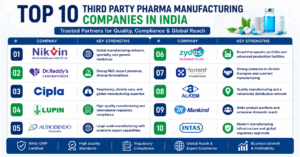
Updated list of the Top 10 Third Party Pharma Manufacturing Companies in India (2026)

S. No. Company Key Strengths
1. Nikvin Healthcare PVT. LTD. Global manufacturing network, speciality and generic medicines
2. Dr Reddy’s Laboratories Strong R&D, export presence, diverse formulations
3. Cipla Ltd. Respiratory, chronic care, and global manufacturing expertise
4. Lupin Ltd. High-quality manufacturing and international regulatory compliance
5. Aurobindo Pharma Large-scale manufacturing with extensive export capabilities
6. Zydus Lifesciences Broad therapeutic portfolio and advanced production facilities
7. Torrent Pharmaceuticals Strong presence in chronic therapies and contract manufacturing
8. Alkem Laboratories Quality manufacturing and a nationwide distribution network
9. Mankind Pharma Wide product portfolio and extensive domestic reach
10. Intas Pharmaceuticals Modern manufacturing infrastructure and global regulatory approvals

top 10 pharma manufacturing companies in india

What should you really look for in a third-party pharma manufacturing company?

It’s not just about the price, even if it kinda feels like that at first, you know.

1. Manufacturing certifications

A trustworthy manufacturer should operate within well-known quality frameworks like these: They should have WHO-GMP certification, ISO certification, GLP compliance, and FSSAI certification for nutraceuticals when it applies, and DCGI-compliant manufacturing practices.

2. Product portfolio

Try picking a manufacturer that brings a wider product range for different dosage forms, such as tablets, capsules, syrups, dry syrups, injectables, ointments, softgels, sachets, protein powders and nutraceutical products. In other words, a broader portfolio makes it easier to build the business later, and it also lets you change direction faster if needed.

3. Quality assurance

Look for this stuff: The company should provide batch testing, modern quality control laboratories, stability studies, documentation support, and standard operating procedures. Plus, when quality stays consistent, it builds customer confidence, and it makes regulatory alignment less painful.

4. Production capacity

Confirm they can handle small-batch production as well as large-scale manufacturing; they should also manage seasonal demand and new business expansion plans. Scalable production is important because it helps prevent supply disruptions when your orders suddenly jump.

5. Packaging and private label support

Many brands require services such as custom packaging, private labelling, product design, barcode printing, and regulatory documentation. Thus, a full-service setup usually makes launches easier, less complicated and faster.

Top Challenges Businesses Face When Partnering with Third Party Pharma Manufacturing Companies in India:

Challenge Recommended Solution
Choosing a trustworthy manufacturer Verify certifications, infrastructure, and market reputation
Product quality inconsistency Partner with manufacturers following strict quality systems
Delayed deliveries Select companies with efficient production planning and logistics
Limited product range Choose manufacturers offering diversified formulations
Regulatory documentation issues Work with experienced contract manufacturing companies
High manufacturing costs Compare overall value, quality, and long-term support instead of only pricing.

Questions to ask before you finalise a pharma product’s manufacturing partner

Before you sign the agreement with pharma product-making companies in India, make sure to ask several questions repeatedly, especially if you receive vague answers. Like,

  • Are your manufacturing facilities WHO-GMP certified?
  • Which dosage forms do you work with, specifically?
  • What’s your minimum order quantity, aka “MOQ”, or like the smallest batch you’ll take?
  • Do you have private label services or white label setups, where our branding can be on them?
  • Can you manufacture custom formulations, or would you rather handle a more niche thing than the usual mix?
  • What kind of quality testing steps do you follow while things are in production, like right during the process?
  • What’s your usual production timeline from the start until it actually gets shipped out?
  • Do you handle regulatory documentation, or assist with putting all that together?
  • How do you ensure the product supply stays uninterrupted, even with normal disruptions?

Consequently, these kinds of questions reduce business risks, and they also help build a more steady long-term partnership.

Why do many businesses prefer third-party manufacturing

Third-party manufacturing often feels simpler, but it can occasionally be complicated in various ways. For instance, it can provide the following:

  • Lower capital investment
  • Faster market entry
  • Professional manufacturing know-how, not just basic assembly
  • Regulatory compliance support
  • Flexible production volumes when demand changes
  • Better operational efficiency day to day
  • More focus on branding and sales efforts
  • Reduced infrastructure costs

This approach works well for startups, established pharmaceutical companies, exporters, and PCD franchise businesses as well.

How to Select the Best Third-Party Pharma Manufacturing Company

Use a quick checklist before you decide, because one small detail can matter. Consider:

  • WHO-GMP-certified manufacturing facility
  • Solid market reputation
  • Broad product portfolio
  • Modern manufacturing infrastructure
  • Transparent pricing
  • Reliable quality assurance
  • Private label manufacturing support
  • Timely product delivery
  • Regulatory documentation assistance
  • Dedicated customer support

If a manufacturing partner matches these points, they’re generally better positioned to support your business as it expands, grows, and scales.

Conclusion:

We just tell you in the end that India still feels like one of the most appealing places for third-party pharma manufacturing, mainly because of its strong production capabilities, experienced and skilled workforce, regulatory know-how, and yes, competitive costs. Whether you are launching a fresh pharmaceutical brand or trying to grow an existing product lineup, picking the right Pharma Manufacturing Companies in India can end up affecting product quality, supply dependability, and also the long-term direction of your business. However, rather than deciding only on price, it’s better to compare manufacturers through their certifications, quality systems, manufacturing capacity, product range, documentation support, and after-sales service. For this reason, when you make a well-informed choice, it becomes easier to build a more solid and sustainable pharmaceutical business.

Frequently Asked Questions (FAQs)

Q1: What is third-party pharma manufacturing, kinda?
A: Third-party pharma manufacturing is basically a contract manufacturing model, where one company produces pharmaceutical products for another company, but the whole thing runs under the other company’s brand name, if that makes sense.

Q2: Who should use third-party pharma manufacturing services, actually?
A: Pharmaceutical companies, startups, PCD franchise businesses, exporters, wholesalers, distributors, and healthcare brands can all benefit. In short, if someone wants production without setting up everything themselves, contract manufacturing can help.

Q3: What certifications should Pharma Manufacturing Companies in India have?
A: Ideally, you should check for WHO GMP certification, ISO certification and also whether they follow relevant Indian pharmaceutical regulations properly. No compromises, since compliance matters.

Q4: What products can be manufactured through third-party pharma manufacturing?
A: Typically, manufacturers can make tablets, capsules, syrups, injectables, ointments, softgels, sachets, nutraceuticals, and a bunch of other pharmaceutical formulations.

Q5: How do I choose the Best third party pharma manufacturing companies in India?
A: Before you decide, take a look at the company’s certifications and the sort of manufacturing capacity they run, plus their product portfolio. Furthermore, see how solid their quality assurance systems are and whether they provide regulatory support that makes sense.

General Range Medicine Third Party Manufacturers in India

How to Choose the Best General Range Third-Party Manufacturer in India

Choosing a general range third-party pharma manufacturer in India is all about assessing WHO-GMP certification, supply chain reliability, product portfolio, and cost.


Did you know? India is known as the “Pharmacy of the World”. It meets over 20% of the generic medicines and more than 60% of vaccines needs of the world. The nation owns the third largest pharmaceutical industry in the world by volume.

Therefore, finding a third party pharma manufacturer should not be a big deal. But finding the right one from the crowd of pharmaceutical manufacturers is an entirely different thing. Working with reputed third-party manufacturers ensures you receive quality medicines and other pharma products backed by timely delivery. Plus, they can help you launch your products faster in the market.

This guide walks you through the key factors to consider before choosing a manufacturing partner.

What is A General Range Third-Party Manufacturer?

A General Range Third Party Manufacturers produce a wide range of pharmaceutical products under your brand name. In other words, you hire them to manufacture products for your brand. Some of the general pharma products they manufacture are:

  • Pill
  • Capsules
  • Syrup
  • Dry Syrup
  • Creams and ointments
  • Protein powder
  • Backpacks
  • Drop
  • Soft Capsules

The manufacturer does the manufacturing, packaging, labelling and quality testing. You simply take delivery of finished goods from them and sell them. This way, a trusted third-party manufacturer enables companies to offer a variety of products without the need for in-house manufacturing infrastructure.

How to Choose the Right General Range Third Party Manufacturer in India

Identify Your Business Requirements

Ask yourself these questions:

  • What products do I want to launch? ?
  • What dosage forms are needed??
  • What should be the order volume? ?
  • What are my target markets?

Asking such things will allow you to identify your business needs. As a result, you can shortlist manufacturers who can fit these requirements.

Check Certifications and Compliance

Regulatory compliance is one of the most important factors to consider while choosing a pharma manufacturing partner.

It requires you to check the following things:

  • A WHO-GMP-certified manufacturing facility
  • ISO certification
  • FSSAI approval (if they sell nutraceutical products)

Don’t forget to ask for copies of these certificates to check their validity before entering into any agreement with them.

Evaluate Product Portfolio and Manufacturing Capacity

Look for a manufacturer that has multiple product categories and dosage forms under one roof. This gives you more flexibility as well as grows your business faster.

Check if they manufacture

  • Antibiotics
  • Pain management products
  • Gastrointestinal medicines
  • Multivitamins
  • Dermatology products
  • Padiatric formulations
  • Nutraceutical

This is also where you need to assess their manufacturing capability. Keeping this in mind, ask:

  • Can they produce in large quantities?
  • What is the minimum order quantity?
  • How do they scale up production to meet high demand?
  • What is their average production lead time?

A manufacturer with good production capacity will guarantee uninterrupted supply and faster order fulfilment. With a reliable third-party manufacturer of a general range, you can introduce new products without having to switch vendors often.

Assess Quality Control Systems

Product quality affects your brand reputation. So, make sure your manufacturer has a good quality assurance and quality control team. Find out how they do:

  • The testing of raw materials
  • The quality control process
  • Batch traceability
  • The packaging quality inspections

(Tip: Visit the manufacturing plant to see how they produce and maintain hygiene standards.)

Review Transparency, Pricing, and Support

Of course, cost is an important factor. But it should NOT be the sole deciding factor to choose any pharma manufacturer. A manufacturer with the lowest quote may be cutting corners in the quality. Instead, focus on value.
Compare manufacturers for:

  • Quality of product
  • Price structure
  • Delivery timeframes
  • Options for packaging
  • Customer service
  • Payment conditions

A good manufacturer will be transparent in their process. They should be able to state clearly the cost to manufacture, packaging charges, delivery timelines, and order tracking procedures.

Additional Factors to Consider

Check the manufacturer’s reputation in the industry

In this context, you can check their online reviews, feedback from existing clients, and business experience.

Packaging and Brand Development

Good packaging design can boost your product’s visibility and brand awareness.
Look for a manufacturer that:

  • Has an appealing packaging design
  • Has custom branding
  • Has artwork that complies with regulatory standards
  • Has many packaging options (paper, bottle and plastic)

Shipping and Logistics

Your manufacturer should have a reliable supply system that can help you meet the market demands. Any delay can lead to the loss of customers for your business.
Therefore, ask about their average dispatch times, delivery network, inventory management systems, and emergency order handling.

Nikvin Healthcare Meets Every Standard to Become Your Trusted General Range Third Party Manufacturer

We are one of the trusted third party pharma manufacturers in India in the field of general range, beta range, and cephalosporin. We are backed by a WHO-GMP, GLP and ISO certified manufacturing plant located at the industrial hub of Baddi. We have a wide range of tablets and capsules and we are proud of our experienced and dedicated team of professionals.

Conclusion

Choosing the right third party manufacturer for your general range is a critical business decision. They help diversify your product portfolio, maintain quality consistency, and drive sustainable growth. Decide on the basis of key factors such as certifications, production capabilities, quality systems and transparency.

FAQs on General Range Third Party Manufacturers

Q1: What is a general range third-party manufacturer?
A: A general range medicine third party manufacturers produce a wide range of pharmaceutical products under your brand name.

Q2: Why should pharma companies opt for third-party manufacturing?
A: Third-party manufacturing eliminates the need to set up a product plant for pharma companies as well as provides them with a wide portfolio of medicines.

Q3: How to Verify a Manufacturer’s Quality Standards?
A: Check certifications such as WHO-GMP, ISO and review quality control processes and request a facility audit before entering the partnership with the manufacturer.

Q4: What documents should I ask from a manufacturer?
A: You should request manufacturing licenses, copies of their certifications, quality reports, product specifications, and the necessary approvals for product regulations.

Q5: How important is product portfolio diversity?
A: A diverse product portfolio means you can have many products from one manufacturer at the same time. This allows you to expand your product range without having to change the vendor.

Top 10 Third Party Pharma Manufacturers in Baddi

Top 10 Third-Party Pharma Manufacturers in Baddi (2026) – Trusted & Reliable Pharma Partners

Key Information Details
Industry Third Party Pharma Manufacturing
Location Baddi, Himachal Pradesh
Certifications WHO-GMP, ISO
Product Types Tablets, Capsules, Antibiotics, Beta Lactam Antibiotics, Liquids, Cream, Oinments

Baddi, Himachal Pradesh, has become one of the top pharma manufacturing hubs of India. Baddi attracts pharmaceutical companies, startups and PCD franchise organisations looking for reliable third-party manufacturing services. The success comes from advanced production facilities, skilled labour, adherence to regulations and superior logistical connectivity. These benefits notwithstanding, you need dependable Third-Party Pharma Manufacturers in Baddi. All these reasons make it important to choose the best company from the Top 10 Third Party Pharma Manufacturers in Baddi, which are essential for product quality, on-time delivery and long-term commercial success.

Why Choose Baddi for Third-Party Pharma Manufacturing?

Business owners especially encounter problems such as high production costs, infrastructure investment, quality control needs, and regulatory permits. Third-party manufacturing assists businesses in overcoming obstacles such as high production costs, infrastructure investment and quality control requirements. As a result, genuine third-party manufacturing services enable businesses to consistently focus on their growth.

The key benefits of choosing the right third-party manufacturing brand include:

  • Reduced production and operational expenses.
  • More rapid product launches.
  • Availability of different formulas.
  • Production capacity scalable.
  • Lower investment in productive capacity.
  • Help with professional quality assurance and documentation.

List of top 10 Third-Party pharma manufacturers in Baddi (2026)

1. Nikvin Healthcare

Nikvin Healthcare is renowned for its quality-oriented pharmaceutical manufacturing services and a wide range of products. The company provides manufacturing support for tablets, capsules, syrups, injections and other dosage forms according to high-quality guidelines.

2. JM Laboratories

JM Laboratories is known as a dependable third-party manufacturing solutions provider. The company produces high-quality products, timely delivery and custom manufacturing services for pharmaceutical marketers and franchise organisations.

3. Parinidhi Pharmaceuticals

Parinidhi Pharmaceuticals is a complete contract manufacturer with a focus on regulatory compliance and product consistency. The organisation caters to a wide spectrum of therapeutic niches in India.

4. Strausswell Organics

Strausswell Organics specialises in pharmaceutical and healthcare products manufacturing with the most advanced manufacturing technology. The company is well-known for its quality assurance and its customer-oriented production support.

5. Neptune Life Sciences PVT. LTD.

Neptune Life Sciences is a popular third-party pharma manufacturing company in Baddi that provides third-party pharmaceutical manufacturing services. They have great manufacturing capabilities and diverse product portfolios. Thus, the company’s services are perfectly suited to both the domestic and the foreign market.

6. Krisa Healthcare

Krisa Healthcare provides full-service pharmaceutical manufacturing with an emphasis on quality control, regulatory compliance and the ability to meet production deadlines. So that their customers can develop their pharmaceutical companies.

7. Vadsp Pharmaceuticals

Vadsp Pharmaceuticals provides dependable contract manufacturing solutions for a broad spectrum of product types. The company concentrates on consistent product quality, competitive prices and efficient manufacturing procedures.

8. Cent Cure

Cent Cure is recognised for producing high-quality pharmaceutical formulations as per the industry standards and regulatory requirements. The organisation also helps companies find solid manufacturing partnerships.

9. Tanishka Pharmaceuticals PVT. LTD.

Tanishka Pharmaceuticals Pvt Ltd provides comprehensive third-party manufacturing services comprising advanced manufacturing facilities and quality management systems tailored to meet market demands.

10. Pavittar Pharmaceuticals PVT. LTD.

Pavittar Pharmaceuticals is one of the leading brands of the Third-Party Pharma Manufacturers in Baddi and provides pharmaceutical manufacturing services in multiple therapeutic areas. The company is also known for its commitment to high-quality production, customer satisfaction and long-term business relationships.

How to Choose the Best Third-Party Pharma Manufacturing Company in Baddi?

Before selecting a third-party pharma manufacturing partner, evaluate the following important factors:

  • Is the company WHO-GMP certified?

    Regulatory certifications such as WHO-GMP and ISO indicate that the manufacturer follows strict quality standards and compliant production practices.

  • What types of pharmaceutical products do they manufacture?

    Choose a manufacturer that can support your current product requirements as well as future business expansion plans.

  • Do they provide complete documentation support?

    Proper documentation, including certificates and regulatory records, is essential for compliance and smooth business operations.

  • Can they handle large-scale production?

    Scalable manufacturing capacity ensures uninterrupted supply as your business grows.

  • Do they have a strong delivery track record?

    Timely manufacturing and dispatch help maintain inventory levels and prevent stock shortages.

  • Do they offer custom packaging solutions?

    Customized packaging and branding can improve product visibility and strengthen market positioning.

Challenges of Third-Party Pharmaceutical Manufacturer Selection for Companies

Choosing the right manufacturer from the Top 10 Third-Party Pharma Manufacturers in Baddi is a crucial decision that can make a huge difference for pharma companies, startups, distributors, and PCD franchise businesses. But in practice, most teams face a number of hurdles when it comes to choosing the right partner. The whole process can be daunting because of all the approvals, checks and follow-ups.

1. The constant concern of regulatory compliance

The most important factor is whether the manufacturer really follows GMP, WHO-GMP, ISO and other regulatory rules. And if they don’t do it right, it can cause quality issues, legal problems and also product recalls – which nobody wants.

2. Consistent product quality from batch to batch

The problem is, it’s not unusual to find someone who can consistently deliver the same standard. Also, even small changes from batch to batch can start to harm the brand image and the customers’ trust, and it is then harder to recover later.

3. No manufacturing capacity

Some manufacturers have limited production capacity. So when demand goes up, they just can’t cope with the volume, and this leads to delays, stock shortages and slower business growth.

4. The product portfolio feels too narrow

Many businesses want a few dosage formats like tablets, capsules, syrups, injections and ointments. If the manufacturer has a limited range, then that can be a problem, as you can’t get everything you need under one roof.

5. Deliveries go late, and then it all goes wrong

Late production schedules and shipment delays can upset inventory planning and affect market availability, resulting in lost sales opportunities.

6. Confusing Pricing Pricing can be confusing, and hidden costs can be frustrating

Hidden fees, volatility of raw material costs and non-transparent pricing terms can throw budgets off kilter. Also, the absence of a clear pricing structure can have a negative impact on profitability.

7. Poor support and communication gaps

Unclear or delayed updates on production status, documentation, packaging changes and regulatory obligations easily lead to misunderstandings. This also results in unproductive operations and causes people to recheck tasks several times.

Conclusion

The Baddi pharmaceutical manufacturing ecosystem will continue to grow substantially in 2026 and offer huge opportunities for pharmaceutical companies, startups, and PCD franchise businesses. The top Third-Party Pharma Manufacturers in Baddi are Nikvin Healthcare, JM Laboratories, Parinidhi Pharmaceuticals, Strausswell Organics, Neptune Life Sciences, Krisa Healthcare, Vadsp Pharmaceuticals, Cent Cure, Tanishka Pharmaceuticals and Pavittar Pharmaceuticals. Moreover, when selecting a trustworthy manufacturing partner, it is crucial to evaluate quality certifications, production capacities, compliance requirements, product range, price transparency, and delivery reliability. So, apart from others across India, various factors help businesses and newcomers to prepare to work with a successful and sustainable pharmaceutical enterprise. We are a WHO-GMP certified manufacturer of quality medicines. Contact us now at +91-8920017174.

Frequently Asked Questions (FAQs)

Q1: Who is the biggest third-party pharma manufacturer in Baddi?
A: The best manufacturer depends on your product specifications, budget, certifications, and desired production volume. The production capacity and quality standards need to be evaluated.

Q2: Why is Baddi known as the pharmaceutical manufacturing hub?
A: Baddi has a strong industrial infrastructure, regulatory support, a skilled workforce and a high density of pharmaceutical production units.

Q3: What qualifications should I look for in the Top 10 Third-Party Pharma Manufacturers in Baddi?
A: Validate WHO-GMP, ISO certifications and other applicable regulatory approvals.

Q4: Can startups leverage third-party pharma manufacturing services?
A: Yes, Third-party manufacturing is a great way for startups to reduce investment and get their product to market faster.

Q5: How do you know your pharmaceutical manufacturer is reliable?
A: Look at the certifications, the manufacturing facilities, the product quality systems, the customer feedback, the production capacity and the delivery performance before you make your choice.